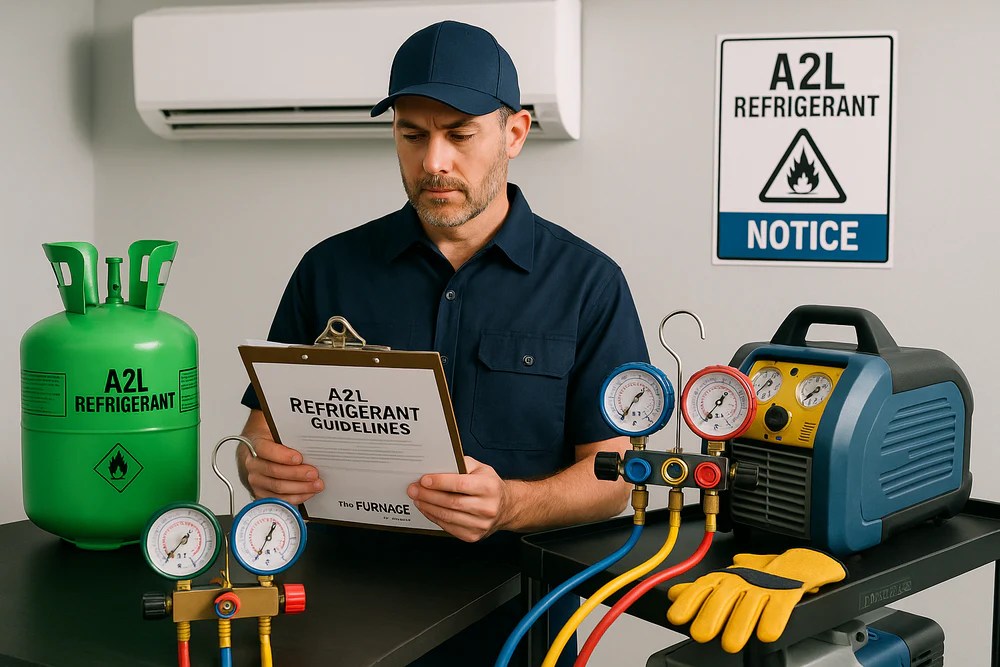
As HVAC professionals know, the heating and cooling industry is undergoing a transition from refrigerants like R-410A to low global warming potential (GWP), or A2L, refrigerants such as R-454B.
When preparing customers for the changes that the refrigerant shift brings, contractors can stay ahead of the learning curve by investing in staff training, purchasing necessary new tools for their HVAC technicians, and educating their residential and commercial customers about the impacts.
As the industry navigates this change, below are lessons and tips to help contractors make a smooth transition to using the new refrigerants.
Dealing with new refrigerants, new rules, and new challenges
In 2025, new residential and light commercial HVAC systems must use low-GWP refrigerants. These refrigerants require new standards, new products, and enhanced safety protocols.
There has been a significant learning curve for the industry, especially in the early stages of the transition. As new equipment has arrived, questions have come up around installation and servicing. Industry trade partners, such as Mitsubishi Electric Trane HVAC US (METUS), have been helpful in providing information, resources, and support.
Things have been changing quickly, and while many HVAC contractors are adapting well, others are still trying to get their bearings. Part of the challenge is that manufacturers have varying requirements.
Availability of A2L-compatible equipment
Initially, the HVAC industry faced challenges due to the limited availability of A2L-compatible equipment and the declining supply of R-410A systems. We’ve worked to balance inventory management with maintaining customer satisfaction.
In some cases, we’ve made two separate service visits for new system installations, first to replace the furnace and evaporator coil and then to return once the outdoor unit becomes available. Thankfully, the industry’s inventory availability has recently improved.
The refrigerant itself is still hard to come by for most contractors. Remaining vigilant and proactive, continuing to depend on trusted industry partners for timely and accurate updates is essential.
Staying ahead through training and education
As the industry receives new information on installation, service procedures, and safety protocols, it is essential that contractor training programs are continuously evolving.
Company pioneers should ensure their teams – not just HVAC installers but sales, service, and support staff – stay informed as new guidance becomes available.
Education is a core value: teams should be encouraged to attend training sessions and share what they learn with their fellow team members.
Regulations, safety procedures, and installation best practices
In preparation for the transition, it’s also vital that contractors upgrade many of their tools, such as vacuum pumps, digital gauges, recovery machines, and manifolds. They should also provide their technicians with the proper training on these tools.
Most importantly, contractors should take advantage of every opportunity from their trade partners, like METUS, and numerous trade affiliations, like the Air Conditioning Contractors of America (ACCA), to obtain guidance.
Constantly research and share information with your team so members are well-versed on regulations, safety procedures, installation best practices, and more.
Educating homeowners on potential upgrades
Most homeowner discussions focus on price and equipment availability rather than refrigerant types, but a few well-informed customers ask about the impact of the equipment refrigerant on their homes. Customers rely on contractors’ expertise to guide them through their purchase. Clear, helpful education builds trust, ensures understanding, and offers peace of mind for customers.
It’s smart and responsible to communicate about the refrigerant change to customers early, so they’re not caught off guard when their current R-410A system eventually needs replacement. They can plan and budget better with this knowledge in mind.
I recommend that New York State contractors let their customers know they may be able to take advantage of the New York State Clean Heat program rebates. These rebates can be combined with federal tax credits included in the Inflation Reduction Act for switching to heat pumps and other efficient solutions. Both programs have incentivized customers to install high-performance heat pump systems.
Improving performance while enhancing comfort
All-climate heat pump systems using A2L refrigerants are said to be more efficient than previous generations. We’re telling our customers who switch that they can potentially lower their utility bills.
The timing of these enhancements fits well with the growing demand the industry is seeing for ductless systems. Our northeastern region – which includes Amherst, New York and the surrounding Buffalo area – has started experiencing above-average temperatures, prompting many people to adopt ductless systems as a cooling solution for the first time.
I would never have anticipated this trend five years ago, and contractors in other parts of the country may be seeing the same trend.
Turning disruption into a path for growth and preparedness
The refrigerant transition has brought its share of challenges, but it has also sparked progress. It is essential for contractors and HVAC professionals to embrace this moment as a catalyst to strengthen their teams, invest in modern tools, and elevate customer education.
By staying connected with trusted partners and industry groups, contractors don’t have to just keep pace, but they can instead position themselves for long-term success in this new era of HVAC.
 Boykin Air