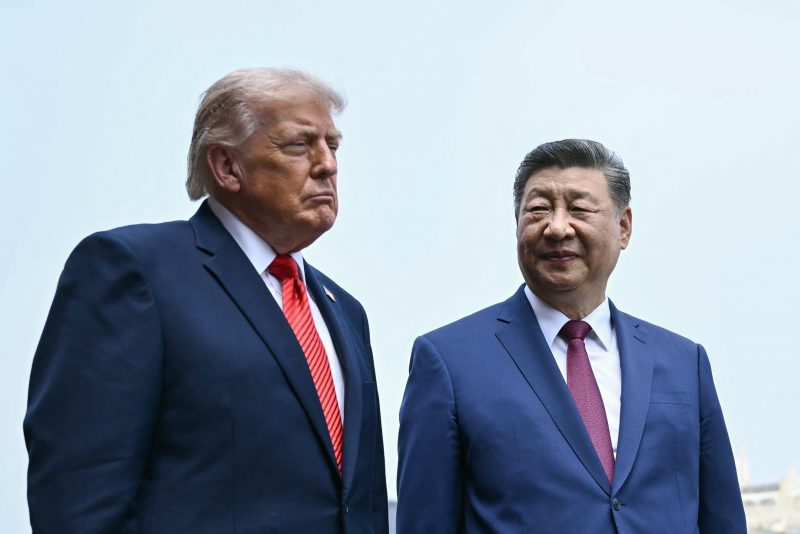
The White House announced that President Donald Trump “had a good meeting” with Chinese President Xi Jinping during their high-profile summit in Beijing, China, and reached common ground on several issues, including economic cooperation, drug trafficking and conflict in the Middle East.
Early on Thursday, the White House released a statement following bilateral meetings between the two world leaders.
“The two sides discussed ways to enhance economic cooperation between our two countries, including expanding market access for American businesses into China and increasing Chinese investment into our industries,” the statement read. “Leaders from many of the United States’ largest companies joined a portion of the meeting.”
Indeed, CEOs from Apple, Boeing, Mastercard, Meta, Nvidia, SpaceX, Qualcomm and several other major companies based in the U.S. made up the entourage traveling with Trump in the hopes of striking good deals for American industries.
“The Presidents also highlighted the need to build on progress in ending the flow of fentanyl precursors into the United States, as well as increasing Chinese purchases of American agricultural products,” the statement continued.
A news release from the People’s Republic of China’s Ministry of Foreign Affairs also highlighted the common interest in agricultural cooperation.
“President Xi pointed out that the two sides should implement the important common understandings we have reached, and make better use of communication channels in the political and diplomatic and military-to-military fields,” the ministry stated. “The two countries should expand exchanges and cooperation in areas such as the economy and trade, health, agriculture, tourism, people-to-people ties and law enforcement.”
A top-priority topic for the summit was the United States’ months-long conflict with Iran, which caused the state visit, which was originally scheduled for April, to be pushed back.
“The two sides agreed that the Strait of Hormuz must remain open to support the free flow of energy,” the White House said. “President Xi also made clear China’s opposition to the militarization of the Strait and any effort to charge a toll for its use, and he expressed interest in purchasing more American oil to reduce China’s dependence on the Strait in the future.”
About a fifth of the world’s oil is exported out of the Strait of Hormuz, which has effectively been closed as a chokepoint used by Iran in its conflict with the United States. Though the U.S. does not rely on this region for the vast majority of its oil imports, as Trump has repeatedly emphasized, his administration has made it clear that opening the Strait to traffic is a non-negotiable as the two countries exchange peace proposals in an indefinite ceasefire.
Xi has also stressed the importance of keeping the Strait of Hormuz open and avoiding militarization of the waterway, reflecting China’s heavy reliance on Middle Eastern energy imports.
Secretary of State Marco Rubio said in a recent interview with Fox News’ Sean Hannity that it’s “in their interest to resolve” the Strait’s blockage.
“We hope to convince them to play a more active role in getting Iran to walk away from what they’re doing now and trying to do now in the Persian Gulf,” he stated.
China also seemed to agree on the most prominent demand the U.S. has made of Iran since it initially bombed Tehran on February 28th — that it abandon its nuclear program.
The White House’s readout concluded, “Both countries agreed that Iran can never have a nuclear weapon.”
In the months leading to the beginning of Operation Epic Fury, Iran continuously denied enriching uranium to weapons-grade levels, though reports suggested it was dangerously close to obtaining its own atom bomb.
White House communications director Steven Cheung declined to say Thursday evening whether Taiwan was discussed during the two-hour-plus meeting, despite Chinese officials stressing that the island was a major concern that could cause “conflict” between the two world powers if not properly addressed.

