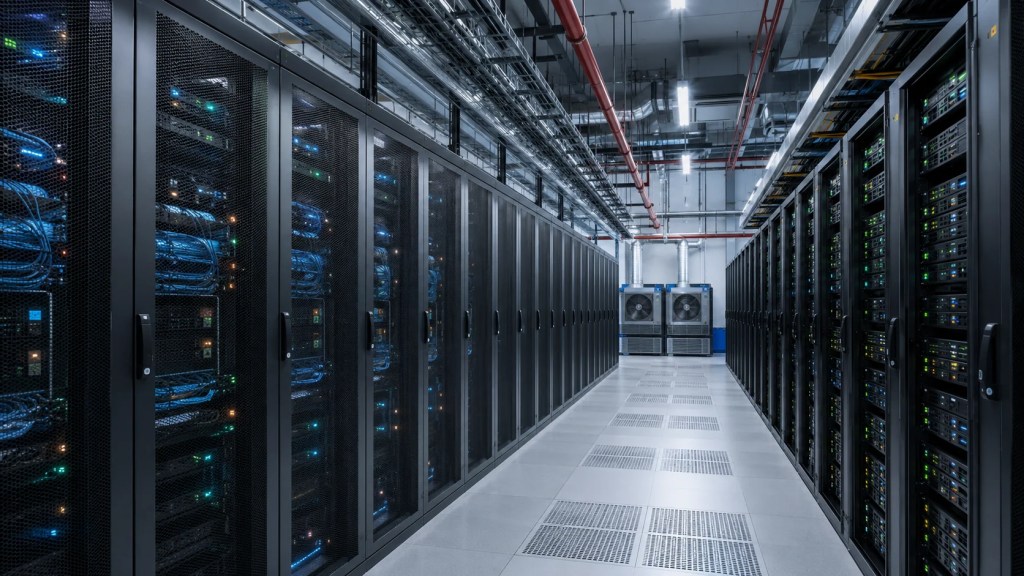
AI is driving demand for advanced systems, and for the contractors who can work on them
The data-center boom is changing what commercial HVAC systems need to do. It is also creating new opportunities for the contractors who design, install, commission, and maintain them.
As AI drives higher computing densities and faster deployment schedules, thermal management has moved from a supporting function to a central part of data-center infrastructure. The cooling technologies built for high-density computing are, in turn, pushing commercial HVAC toward more sophisticated, integrated systems.
For Trane Technologies, that demand is fueling growth. The company reported 50% growth in Americas Commercial HVAC bookings and 130% growth in applied equipment bookings in the second quarter [add year and “year over year” if confirmed].
Matt Orcutt, vice president of system strategy and product management at Trane Technologies, said data centers are only part of a broader shift.
“Our growth reflects a broad-based, diversified demand for modern, energy-efficient building systems, with active momentum across multiple key sectors like higher education, healthcare, government, and data centers,” he said.
Digital infrastructure is an important contributor, Orcutt said, but customers in every market are increasingly focused on resource efficiency, lower utility costs, and better building performance.
Cooling Moves Closer to the Chip
Even so, the data-center opportunity has changed how Trane approaches commercial HVAC.
“The rapid pace of innovation required by the AI infrastructure buildout has reinforced our focus on systems-level innovation, early-stage design collaboration and engineered flexibility,” Orcutt said.
Higher rack densities and shifting computing workloads put greater demands on thermal infrastructure, which means cooling now enters the planning process much earlier in a project.
“We serve as a strategic innovation collaborator across the full lifecycle, working with customers from early concept through delivery, controls, commissioning, and long-term modernization,” Orcutt said.
That approach is changing which cooling technologies get deployed. Orcutt said Trane is seeing a shift toward hybrid thermal architectures that combine air, water, and liquid cooling in coordinated systems. Chillers remain fundamental to managing a facility’s total heat load, but higher-density racks increasingly need cooling closer to the chips themselves.
Trane’s offerings in this area include the LiquidStack CDU 2.X platform for rack-level liquid cooling and the GigaModular CDU. A CDU, or coolant distribution unit, moves coolant between the facility’s cooling loop and the servers. The GigaModular CDU has qualified as an NVIDIA DSX Ready CDU for next-generation accelerated computing platforms.
Caption: The LiquidStack CDU 2.X by Trane Technologies is a highly configurable, 2.5 MW coolant distribution unit designed for demanding AI workloads and high-density GPU platforms. (Courtesy of Trane Technologies)
Modular construction is also gaining ground as operators work around space, construction, and deployment constraints. Trane’s 250-MW AI Factory reference designs use factory-built modular cooling plants from Stellar Energy, with dry fluid coolers stacked directly on top. According to Trane, this configuration can shrink the dry-cooler footprint by up to 40% while achieving zero Water Usage Effectiveness, meaning it consumes no water for cooling.
More Technology, More Technicians
For HVAC contractors, the most important takeaway may be that more sophisticated technology doesn’t reduce the need for skilled labor. It increases it.
“As building technology gets more sophisticated, the need for hands-on technical expertise in the field actually increases,” Orcutt said. “We view technology and people as partners in this transition.”
That creates opportunities well beyond initial installation, including commissioning, controls, service, troubleshooting, maintenance, and long-term modernization.
Trane is also building training around the data-center market. Its Advanced Technology Training Center offers a certification pathway for data-center technicians, focused on the precision and technical depth needed to maintain uptime and efficiency.
For contractors, traditional HVAC skills remain essential, but added expertise in controls, liquid cooling, commissioning, and data-center operations can set a company apart.
A Long-Term Commercial Opportunity
Orcutt does not expect demand to vanish when the current wave of AI construction slows.
“The continuous expansion of digital infrastructure suggests that the demand for highly efficient, resilient systems will remain a priority for years to come,” he said.
He also sees a broader payoff. Technologies developed to optimize high-density data centers, including predictive optimization, real-time diagnostics, and smart controls, can be applied to existing commercial buildings. Orcutt pointed to the large amount of energy commercial buildings consume and the chance to cut waste through smarter management.
“The predictive optimization and real-time diagnostics honed in high-density data environments are actively paving the way for other sectors to modernize their existing physical infrastructure and operate more efficiently,” he said.
The market is also pushing manufacturers toward new approaches to efficiency. Trane has demonstrated an 800-volt direct-current chiller proof of concept developed with Eaton and Danfoss. By using a direct DC feed, the system is designed to bypass traditional power-conversion steps and improve efficiency by up to 2%. According to Trane, that could reclaim up to 1.8 MW in a large facility [confirm facility size, roughly 90 MW].
Designing for What Comes Next
Over the next five years, Orcutt expects physical constraints such as energy, water, and local infrastructure capacity to increasingly shape where and how data centers are built. That could favor modular, repeatable systems that let operators add capacity in phases instead of overbuilding upfront.
“The digital infrastructure underpinning the AI era is no longer simply an engineering challenge but one of the defining industrial and economic stories of our time,” Orcutt said.
For commercial HVAC contractors, the opportunity goes beyond building the next generation of data centers. It also means helping those facilities run efficiently as their cooling needs evolve, and applying what the industry learns from them to the far larger commercial building market.
Developing a thermal strategy early, Orcutt said, lets organizations build for today’s needs while keeping systems adaptable for what comes next.

